I Wrote the Beginner’s Guide to Shogi Shapes I Felt Was Missing
Contents
It’s been a while. Saiba here.
I previously published a Kindle book about ways of thinking in shogi for beginners and kyu-level players. Thanks to you, it seems to have reached far more readers than I expected, and I’m really happy about that.
Every time I see the sales numbers rise, I feel grateful that someone else has read it today. 🙇♂️
↓ Here’s the article I wrote when I published my first book.
↓ Kindle sales page for my first book, Shogi Beyond the Rules.
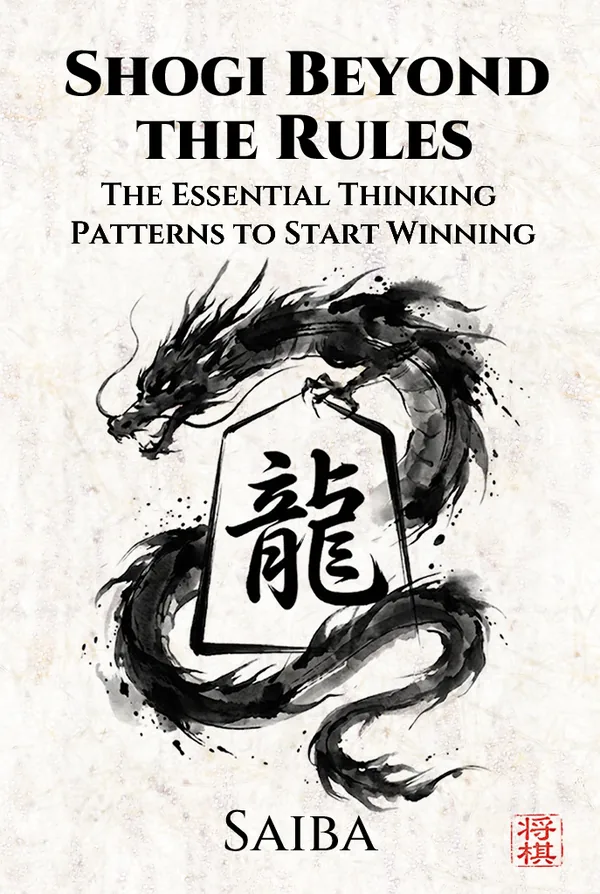
Shogi Beyond the Rules
View on AmazonAnd now the second book I wanted to write is finished and on sale!
The first book focused on ways of thinking, but there was an important topic I had to leave out because of the length and work involved.
I’ve now used that material to write and publish a second book for beginners!
This time, the topic is shape in shogi.
↓ Here’s the product page! Kindle Unlimited subscribers can read it at no additional cost. I’d be delighted if you had a browse!
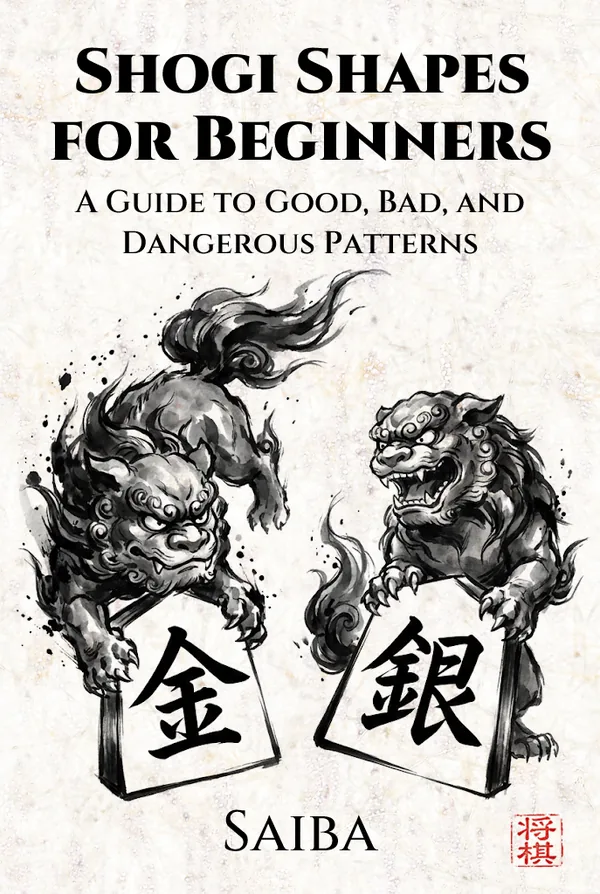
Shogi Shapes for Beginners
View on AmazonAlthough this is Volume 2, it stands independently of the first book, so it’s fine to start here.
Why Shape Matters
In shogi, “shape” generally means the arrangement of pieces in a particular part of the board.
And shape is extremely important both for improving at shogi and for winning actual games.
Strong players definitely notice whether a position has good or bad shape.
For example:
That arrangement of golds and silvers should make a solid defense.
Those pieces are poorly placed in relation to each other, so they look vulnerable to a fork.
The defense in front of the king is thin and looks dangerous.
Those are the kinds of things they see.
The Problem: Too Little Material for Learning Shapes
A feel for good and bad shape is crucial in shogi, but I think there’s currently very little material that teaches it systematically.
Even among strong players who understand good and bad shape, I think most were never directly taught it by anyone.
They learn through repeated painful losses or by piecing together scraps of advice such as “the square in front of a knight is weak” and “wall formations are dangerous.” It’s a very roundabout way of learning.
I feel that good and bad shape should really be one of the first things beginners and kyu-level players learn.
Watching beginners and newer players, I often see them leave a bad formation unaddressed, only for the opponent to exploit it and win in one rush.
This is just as serious as not knowing how to checkmate or attack—perhaps even more so.
Studying openings or solving checkmate puzzles won’t easily lead to wins if you’re unaware of the danger of bad shape.
You end up thinking, “I don’t know why I lost,” or “Maybe shogi just isn’t for me…”
That’s enough to discourage someone before they’ve had a chance to find shogi fun.
A Feel for Shape Is Like Basic Form in Sports
I think developing a basic feel for shape is very similar to learning proper form in a sport.
If you keep practicing with poor technique you’ve invented yourself, results are hard to come by.
Your form might gradually improve with practice, but that takes a very long time and is a roundabout route.
Learning to recognize good and bad shape in shogi feels much the same to me.
Once that foundation—your form—is in place, you’re less likely to fall apart in a game.
Avoid bad shape and aim for good shape, and good moves come to mind more naturally, making your play more accurate.
Even strong players can’t easily break down a position made up of sound formations.
It should definitely make winning practical games easier.
And once you understand the basics, good and bad shape are universal knowledge you can apply even when you change openings.
I Made a Beginner’s Guide Covering Those Fundamentals
This book is an introductory guide where beginners and kyu-level players can learn the fundamentals of shape in one place. My aim was to cover all the important practical shapes.
There are very few books focused exclusively on shape, so I think it offers a fairly unusual approach.
In the book, I divide shogi shapes into:
Bad shapes: formations you should almost always avoid;
Dangerous shapes: formations that may be harmless but can be fatal in certain situations. “Dangerous shape” is my own term;
Good shapes: sound, well-reasoned formations.
Using these three categories, I’ve tried to cover the shapes that appear frequently in real games as comprehensively as possible.
For each one, I carefully explain why it’s bad, when it becomes dangerous, or why it’s desirable.
I’ve also avoided long strings of move notation—such as Black P-76, White P-34—as much as possible, and included frequent diagrams to make it easier for beginners to read.
Who It’s For
The intended audience is beginners through kyu-level players. On Shogi Wars or Shogi Quest, I think it should be useful up to around 3-kyu.
For readers close to beginner level, I hope it serves as a comprehensive introduction to the basics of shape!
Players around 3- or 4-kyu will probably already know quite a bit of the material.
But a quick read may reveal formations whose risks you hadn’t fully appreciated, or deepen your understanding of ones you only vaguely knew. I think it can help correct your form.
Stronger players probably won’t get much from the book itself. But if this article resonates with you, a like would encourage me! <(_ _)>
You don’t know what went wrong, but suddenly your opponent has landed a devastating tactic.
You solve checkmate and next-move puzzles but still struggle to win and feel stuck.
You mainly watch shogi but want to understand a little more of what’s happening.
If any of those sound familiar, I’d love you to give the book a try!
To Finish
I love shogi, and I’m writing this introductory series because I want more people to enjoy playing it and keep going without becoming discouraged.
I’d be very happy if this book helped interested readers take another step toward getting stronger.
If the series is well received, I’d like to continue writing about topics where beginners and kyu-level players tend to get stuck and few comparable books exist.
If you read it, reviews and impressions are very welcome!
They encourage me to keep writing. 🙇♂️
Thank you for reading such a long post!
Corrections to This Book
Typo
In the section on the “wall shape” that blocks the king’s escape route:
Incorrect: White is threatening mate with S-68. → Correct: G-68.
In the section on a promoted bishop occupying the center:
Incorrect: White would normally like to expand their formation with a move such as P-74. → Correct: P-64.