I Published a Short Kindle Book: “Is Three-Minute Blitz Really Shogi?”

Contents
I’ve published a new short shogi book on Kindle.
It’s called Is Three-Minute Blitz Really Shogi? How to Think About and Live with the Game of Three-Minute Shogi and is available in Japanese.
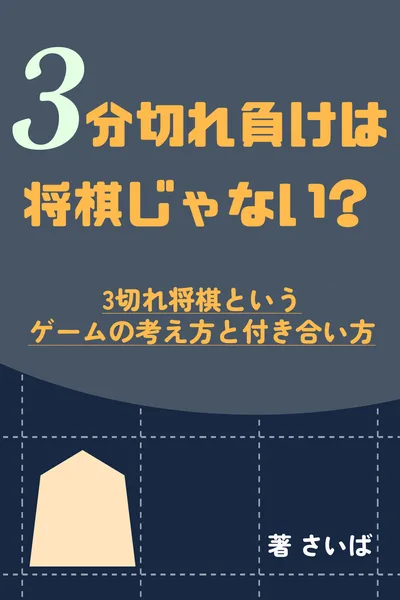
Is Three-Minute Blitz Really Shogi? (Japanese edition)
View on Amazon JapanIt’s included in Kindle Unlimited!
This isn’t a strategy guide for winning lots of three-minute games, or an improvement book explaining opening theory and endgame technique in detail.
It’s more of an essay-style reflection with an unusual focus: how to understand and approach three-minute shogi so you can enjoy it without getting more irritated than necessary. I put it together from thousands of games on Shogi Wars and my experience as a 4-dan player.
I’ve had various thoughts and feelings about three-minute shogi for a long time. I turned them into this short book in the hope they might be useful to someone.
Before I knew it, this became my fifth shogi book.
I do want to give something back to shogi and help more people enjoy it, though I’m not entirely sure why I’m putting quite this much effort into it, haha.
A Book About My Personal Approach to Three-Minute Shogi
The topic this time is three-minute sudden death, commonly called “3-kire” in Japan.
I think many players now enjoy this format, especially on Shogi Wars, and it has become a fairly standard way to play.
I’ve played thousands of three-minute games, mainly on Shogi Wars. Having reached 4-dan, I think it’s fair to say I’ve spent quite a lot of time on it.
I was actually promoted to 4-dan while writing this book!
There’s no doubt it’s an exciting game you can play casually in a short time. It’s hard to find many other activities that let you enjoy such concentrated thinking in under six minutes total.
On the other hand, three-minute shogi has its own particular frustrations. You can lose a winning position on time or fall into quick traps and lose several games in a row.
There really are moments when you wonder, “Is this even shogi?”
I’m also a little doubtful about how much it helps you improve at shogi itself. At the very least, I think you’ll hit a ceiling if three-minute games are all you play.
Treat Three-Minute Shogi as Time Spent in a Different Mode
After playing for a long time, I came to think of three-minute shogi as
a distinct mode of shogi, with a different structure of winning and losing from ordinary games.
- Making your opponent run out of time is a realistic winning strategy.
- There’s no time for long, deep calculation; it becomes a contest of quick reactions and intuition.
- As a result, forceful attacks and surprise strategies are more likely to work.
As a player, I feel these things have a major effect on the game.
Beyond what happens on the board, there are also questions about your relationship with the game:
- It’s questionable whether you can improve by playing this format alone. At least, I wouldn’t really recommend it.
- Getting too accustomed to it risks making your play careless. Conversely, after a long break, your thinking may not keep up with the speed.
- It’s tempting to keep playing endlessly.
Those are some of the factors I have in mind.
A Rough Outline
Because of these differences, I think treating it simply as an extension of ordinary recreational shogi can lead to mismatched expectations and frustration.
In this book, I’ve collected thoughts and tips about the particular ways three-minute shogi works as a game.
More specifically, I discuss ideas like these that may help you enjoy three-minute shogi with a healthier mindset:
- Practical ways to reduce losses where your time is drained while your opponent stays comfortable;
- How to reset after a loss rather than carry it into game after game;
- How to deal with pointless checks and surprise openings;
- The skills three-minute shogi develops, and those it doesn’t develop easily;
- Finding a balance that lets you enjoy it over the long term.
Who I Wrote This For
I wrote the book for people such as:
- Players struggling to get good results in three-minute games;
- People who feel uneasy about games decided by running out of time;
- Players who carry frustration from a loss and immediately hit the next-game button;
- New shogi players who aren’t sure how to approach the three-minute format.
The intended readers are beginners and kyu-level players. No particular background knowledge is needed, and I’ve kept it short enough to read quickly.
It won’t suddenly make you win more three-minute games. But I think it can help you stop blaming yourself excessively after losses or playing one game after another while frustrated.
I’d be happy if it helped you see three-minute shogi a little more casually as a different mode, and find a more comfortable way to enjoy it!
Is Three-Minute Blitz Really Shogi? (Japanese edition)
View on Amazon JapanIt’s included in Kindle Unlimited! You can sign up here.
